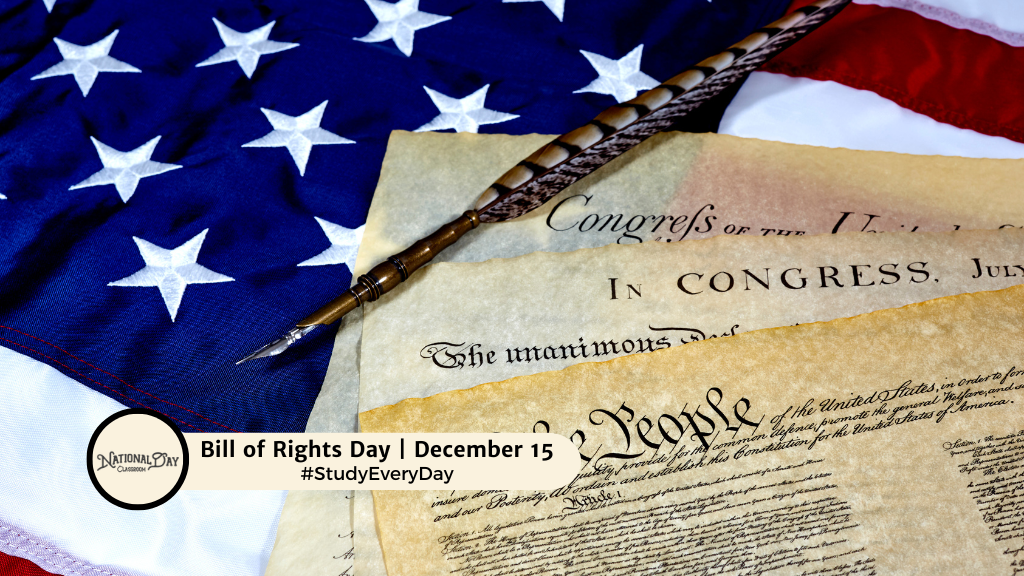
December 15th commemorates the day in 1791 when the first ten amendments to the U.S. Constitution were ratified.
Bill of Rights Classroom Lesson: “Your Rights in Action”
1. Objectives
By the end of this lesson, students will be able to:
- Identify the rights guaranteed by the first ten amendments.
- Analyze historical and contemporary scenarios related to these amendments.
- Evaluate the importance of the Bill of Rights in protecting individual liberties.
2. Materials Needed
- Copies of the Bill of Rights (simplified or original text)
- Handouts with Scenario Cards (see Section 4)
- Chart paper or a whiteboard/projector
3. Introduction (15 minutes)
- Hook: Ask students: “If you could write the most important rule for our classroom or school, what would it be and why?” Discuss their answers, highlighting the idea of establishing fundamental protections.
- Context: Explain that after the U.S. Constitution was ratified, many people, known as Anti-Federalists, feared the new government had too much power and demanded a list of rights to protect the people. The Bill of Rights was the answer.
- Review: Distribute the Bill of Rights text. Briefly go through each amendment, asking students to identify the core right protected (e.g., Amendment I: Speech, Religion, Press, Assembly, Petition; Amendment IV: Search & Seizure).
4. Activity: “Rights in Action” Scenarios (30–45 minutes)
This is the core activity where students apply their knowledge.
A. Preparation (5 minutes)
- Divide the class into small groups (3-4 students).
- Give each group a set of Scenario Cards. Each card presents a short situation where an individual’s rights might be at stake.
B. Group Work (20-30 minutes)
For each scenario, the group must discuss and determine:
- Which Amendment(s) is/are involved?
- What is the argument for the individual’s rights being violated?
- What is the argument for the government/authority’s actions being justified?
- How should the situation be resolved according to the Bill of Rights?
C. Example Scenarios:
- Scenario 1 (1st Amendment): A student wears a shirt to school that criticizes the principal’s new policy. The principal tells the student to remove it. (Focus on freedom of speech)
- Scenario 2 (4th Amendment): The police suspect a person is hiding stolen goods. Without a warrant, they kick in the person’s door and search the house. (Focus on unreasonable search and seizure)
- Scenario 3 (5th/6th Amendment): A person is arrested and held for three years without ever being formally charged with a crime or given a trial date. (Focus on due process, speedy trial)
- Scenario 4 (2nd Amendment): The city passes a law banning all firearms, including those kept locked in private homes for protection. (Focus on the right to keep and bear arms)
5. Debrief & Discussion (15-20 minutes)
- Have each group share their analysis of one scenario with the class.
- Facilitate a class discussion:
- “Were any of the scenarios difficult to decide? Why?”
- “In your opinion, which right in the Bill of Rights is the most important for students your age? Why?”
- “Can one person’s rights sometimes conflict with another person’s rights or the safety of the community? How does the Bill of Rights help balance these?”
6. Conclusion (5 minutes)
- Wrap-up: Emphasize that the Bill of Rights is not just an old document; it is a living part of American law that is debated and applied every day, ensuring that the government cannot infringe upon fundamental freedoms.
- Assessment/Homework: Ask students to find a current news story (online or print) that involves one of the first ten amendments and write a paragraph explaining which amendment is at stake and how the situation relates to the text of the Bill of Rights.
Download the PDF Lesson Right Here!