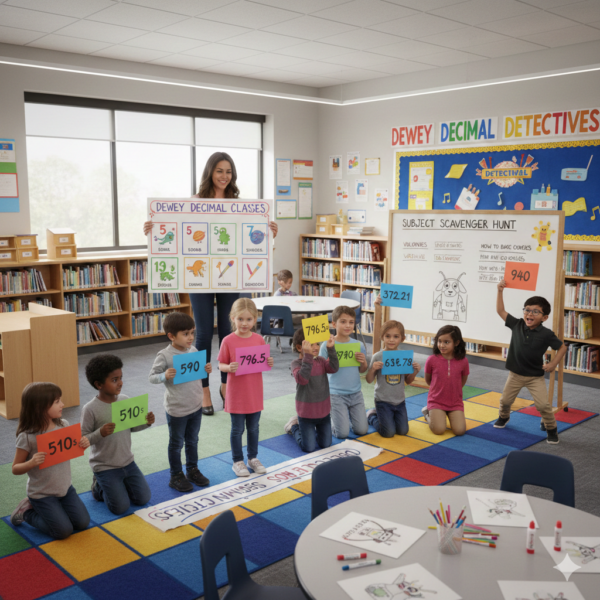
📚 Introduction to the Dewey Decimal System
The Dewey Decimal System, created by Melvil Dewey in 1876, is the most widely used system for organizing nonfiction books in libraries worldwide. And, we celebrate on December 10th every year! It works by dividing all human knowledge into ten main classes, allowing books on the same subject to be shelved together.
Key Concepts
- Classification: Organizing books by subject.
- Notation: The unique numeric code (call number) assigned to each book.
- Hierarchy: Knowledge is divided into classes, divisions, and sections, moving from general to specific.
🔟 The Ten Main Classes (The Hundreds)
The DDC uses Arabic numerals from 000 to 900 to represent ten broad categories, known as the “Hundreds” or Main Classes.
| Range | Class Name | Examples of Topics |
| 000s | Computer Science, Information & General Works | Encyclopedias, UFOs, Computer Programming, Libraries, Journalism |
| 100s | Philosophy & Psychology | Ethics, Logic, Emotions, Superstitions, Death and Dying |
| 200s | Religion | The Bible, Christianity, Mythology, Judaism, Islam, World Religions |
| 300s | Social Sciences | Law, Economics, Education, Customs, Political Science, Anthropology |
| 400s | Language | Dictionaries, Linguistics, Specific Languages (French, Spanish, etc.) |
| 500s | Natural Sciences & Mathematics | Math, Astronomy, Physics, Chemistry, Biology, Animals, Plants |
| 600s | Technology (Applied Sciences) | Medicine, Engineering, Cooking, Agriculture, Childcare, Aviation |
| 700s | Arts & Recreation | Painting, Music, Photography, Sports, Games, Theater, Architecture |
| 800s | Literature | Poetry, Plays, Essays, Fiction (sometimes separated), Literary Criticism |
| 900s | History & Geography | History of continents/countries, Travel, Ancient History, Biographies |
🔎 The Hierarchical Structure
The DDC uses a hierarchical system, meaning the numbers move from broad to very specific. The full number is often called the call number.
1. The Main Class (Three-Digit Number)
The first three digits define the subject. For example, the number 599 falls within the 500s (Natural Sciences).
2. Divisions and Sections (Further Breakdown)
Each Main Class (e.g., 500) is divided into ten Divisions (e.g., 590: Zoology) and then into ten Sections (e.g., 599: Mammals).
3. Decimals (Specific Topic)
After the initial three digits, a decimal point is used to add numbers that represent increasingly specific sub-topics. You always read the numbers after the decimal point as individual digits, not as whole numbers (e.g., $.756$ is “point-seven-five-six”).
Example of a full call number: $599.756$ (Tigers)
- 500: Natural Sciences
- 590: Zoology (Animals)
- 599: Mammals
- 599.7: Carnivores (Flesh-eating mammals)
- 599.756: Felidae (Cat family), specifically Tigers
🧑🤝🧑 Shelf Arrangement
The most important part of the DDC is understanding how the numbers dictate the book’s location on the shelf:
- Read the numbers numerically before the decimal point:
- $599$ comes before $600$.
- $598$ comes before $599$.
- Read the numbers after the decimal point as if they were a list of whole numbers:
- $599.7$ comes before $599.8$.
- $599.75$ comes before $599.76$.
- $599.756$ comes before $599.76$.
| Number Sequence | |
| 942 | (History of England) |
| 942.06 | (History of the Stuart Period) |
| 942.063 | (History of the English Commonwealth) |
| 943 | (History of Germany) |
🎯 Activity Ideas
1. The Call Number Sort Challenge
- Task: Give students index cards with various Dewey Decimal call numbers (e.g., 510, 599, 796.5, 372.21, 940) and have them physically line up in the correct shelf order.
2. Subject Scavenger Hunt
- Task: Provide a list of subjects (e.g., “how to bake cookies,” “volcanoes,” “the history of World War II”) and have students use the Main Classes chart to guess the appropriate 100s-class number.
- Follow-up: Have them use an online library catalog or a chart of the Divisions to find the full three-digit number.
3. Create a New Topic
- Task: Have students invent a brand-new subject of study (e.g., “The Psychology of Robot Pets”). Challenge them to figure out where it would logically fit into the existing 10 main classes and propose a new, specific call number.