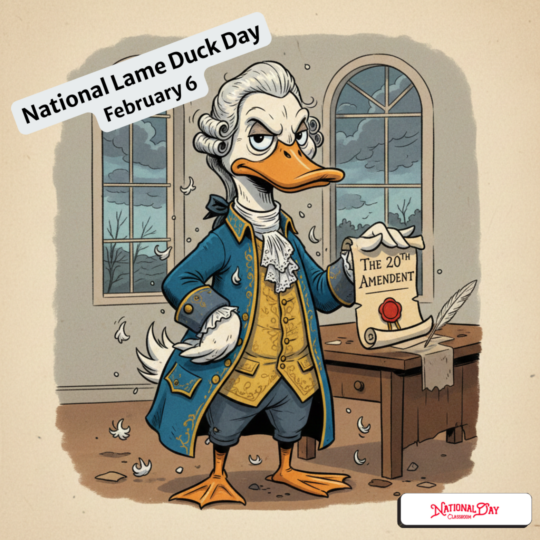
In politics, a Lame Duck is an official who remains in office after their successor has been elected. Because they aren’t sticking around, their political “wings” are clipped; they lose their influence because everyone is already looking toward the next person in charge.
Lesson Plan: The Flight of the Lame Duck
1. The Origin Story
Start with a quick hook about the term. It actually comes from the London Stock Exchange in the 1700s, referring to a broker who couldn’t pay their debts and had to “waddle” away in disgrace.
In politics, it’s less about debt and more about diminishing power.
- Why are they “lame”? They can’t easily pass new laws because other politicians are waiting for the “new boss” to arrive.
- Who are they? Usually a President or Member of Congress who lost an election, chose not to run again, or reached their term limit.
2. The Legal Fix: The 20th Amendment
Before 1933, the “Lame Duck” period lasted for four months (November to March). This was a disaster during crises like the Great Depression, as the country sat in limbo waiting for FDR to take over while Herbert Hoover’s power evaporated.
The 20th Amendment shortened this gap by moving Inauguration Day from March 4th to January 20th.
3. Classroom Activity: “Power vs. Freedom”
Divide the class into two groups to debate the “Lame Duck Paradox.” Even though these leaders lose influence, they gain a unique kind of freedom.
| The Lame Duck Downside | The Lame Duck “Superpower” |
| “Dead on Arrival”: Opponents often ignore their proposals. | Political Courage: They can make unpopular but necessary decisions without fearing a lost election. |
| Staff Exodus: Top advisors start looking for new jobs. | Pardons: Presidents often use this time to issue controversial executive pardons. |
| Gridlock: Major legislation usually stalls until the new term. | Legacy Building: They focus on finishing long-term projects or foreign policy deals. |
4. Discussion Prompt: The “Golden Hour”?
Ask your students: If you knew you were leaving your job in two months and didn’t have to worry about being “re-hired” by the voters, what is one big change you would try to make?
Teacher’s Tip: Use this to discuss recent transitions or local examples (like a retiring principal or a graduating senior class officer) to make the abstract concept feel more personal.
National Lame Duck Day is celebrated on February 6th specifically because that was the day the 20th Amendment was ratified in 1933. Before that, the “lame duck” period was a marathon, not a sprint!
Here is some of the best trivia to share with your students:
1. The “Waddling” Stockbrokers
Long before it was used in the White House, “Lame Duck” was an insult in the 1700s London Stock Exchange. It referred to a broker who couldn’t pay his debts and had to “waddle” out of Exchange Alley in disgrace. By the 1830s, the term migrated to the U.S. to describe “broken-down” politicians who were essentially broke on political capital.
2. The Four-Month Ghost Town
Before 1933, a president elected in November didn’t take office until March 4th.
- The Reason: In the 1700s, it took months for news to travel by horse and for newly elected officials to pack their bags and move to D.C.
- The Problem: By the 1900s, trains and telegrams made this wait unnecessary. In 1932, during the Great Depression, the country had to wait four agonizing months for FDR to take over while the economy spiraled, because Herbert Hoover no longer had the “mandate” to act.
3. “The Lame Duck Amendment”
The 20th Amendment is actually nicknamed the “Lame Duck Amendment.” It chopped the transition time down from four months to about ten weeks.
- Fun Fact: If the 20th Amendment hadn’t passed, Abraham Lincoln might have been able to prevent some of the early escalations of the Civil War. Instead, he had to sit at home in Illinois for four months while Southern states seceded, because he didn’t have the legal power to stop them yet.
4. The Productive “Quackers”
Being a lame duck doesn’t always mean being lazy. Some of the most famous (and controversial) moments in history happened during these sessions:
- The Midnight Judges: In 1801, John Adams stayed up until his very last night in office signing appointments for new judges just to annoy his rival, Thomas Jefferson.
- The Impeachment: President Bill Clinton was actually impeached by the House of Representatives during a lame-duck session in 1998.
- The Censure: The Senate famously voted to condemn (censure) the controversial Senator Joseph McCarthy during a lame-duck session in 1954.
5. Why Ducks?
Biologically, ducks are “lame” when they are molting. During the time they shed their old feathers to grow new ones, they cannot fly, making them vulnerable to predators. It’s a perfect metaphor for a politician who has lost their “flight” (power) but is still stuck on the pond.
Download the PDF Lesson and Quiz here.