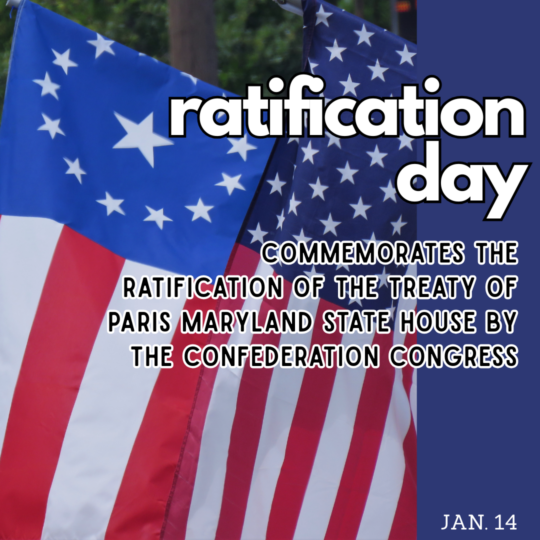
Ratification Day (January 14th) is often overlooked in favor of the more “famous” holidays, but it marks the exact moment the United States officially became a sovereign nation in the eyes of the world.
It commemorates the day in 1784 when the Confederation Congress, meeting in Annapolis, Maryland, ratified the Treaty of Paris. This act formally ended the Revolutionary War.
Here are a few ways educators can turn this into a compelling lesson:
1. The “Race Against Time” Narrative
The history behind the ratification is surprisingly dramatic. Under the Articles of Confederation, the Congress needed a quorum of nine states to ratify the treaty.
- The Stakes: Great Britain had set a six-month deadline for the documents to arrive back in London.
- The Drama: Severe winter weather made travel nearly impossible. For weeks, Congress sat with only seven or eight states represented.
- The Resolution: At the last moment, delegates from South Carolina and Connecticut arrived through the snow, allowing the vote to happen just in time to send the documents across the Atlantic by ship.
2. Analyzing the Treaty of Paris
Educators can use primary source excerpts to show students what the “fine print” of American independence actually looked like.
| Key Provision | Impact on the New Nation |
| Article 1 | Britain recognizes the U.S. as “free sovereign and independent states.” |
| Article 2 | Defines the new U.S. boundaries (extending west to the Mississippi River). |
| Article 5 | Recommends the “earnest” return of confiscated Loyalist property. |
3. The Power of a Signature
This is a great moment to discuss the transition of power. Just a few weeks prior, in the same room at the Maryland State House, George Washington resigned his commission as Commander-in-Chief.
- Lesson Theme: The shift from military rule to civil law. Ratification Day represents the beginning of the “Diplomatic Era” for the U.S.
Classroom Activity Idea: “The Great Quorum Hunt”
Have students role-play as “riders” trying to find missing delegates from different states. They have to explain to the “delegates” why their presence in Annapolis is vital for the treaty to pass before the deadline. It highlights the weaknesses of the Articles of Confederation while celebrating the eventual success.
Student Worksheet: The “Birth Certificate” of a Nation
Date: January 14, 1784 | Location: Annapolis, Maryland
Part 1: Contextualizing the Source
Read the following excerpt from the Preamble of the Treaty:
“…It having pleased the Divine Providence to dispose the Hearts of the most Serene and most Potent Prince George the Third… and of the United States of America, to forget all past Misunderstandings and Differences… 1have agreed upon and confirmed the following Articles…”
- Tone Check: How would you describe the language used between the British King and the former colonies? Does it sound like an argument, or something else?
- The “Missing” Piece: The Treaty was signed in Paris in September 1783, but wasn’t “official” until today, January 14. Why did it take months for the U.S. Congress to ratify it? (Hint: Think about 18th-century travel).
Part 2: Analyzing the Key Articles
Analyze the simplified excerpts below and answer the “So What?” questions.
| Article Excerpt | The “So What?” |
| Article 1: “His Brittanic Majesty acknowledges the said United States… to be free sovereign and independent states; that he treats with them as such…” | Q: Why was it vital for the King to name each state specifically rather than just saying “the colonies”? |
| Article 2: “The following are and shall be their boundaries… from the Northwest Angle of Nova Scotia… along the middle of the [Great] Lakes… to the River Mississippi.” | Q: Look at a map of the 13 colonies. How much did the size of the U.S. change because of this Article? |
| Article 5/6: “That Congress shall earnestly recommend to the legislatures of the respective states to provide for the restitution of all estates, rights, and properties… of real British subjects [Loyalists].” | Q: This was the most controversial part. Why would Americans be hesitant to give back property to people who fought against them? |
Discussion Questions for the Classroom
1. The Power of “Legitimacy”
- Question: Even though the fighting mostly stopped after Yorktown (1781), why couldn’t the United States start functioning as a real country until this document was ratified in 1784?
- Focus: Discuss the importance of international recognition, trade, and the ability to borrow money.
2. The Weakness of the Articles of Confederation
- Question: It took months to get 9 out of 13 states to show up to vote on this treaty. If a modern emergency happened, could our current government wait three months for a vote?
- Focus: Use this to transition into why the Constitution eventually replaced the Articles of Confederation.
3. The “Victors” and the “Excluded”
- Question: The Treaty of Paris mentions the British, the Americans, and the French. Who is notably missing from the negotiations regarding the land “west to the Mississippi”?
- Focus: Discuss the impact on Native American nations whose lands were being “given away” by two powers that didn’t technically own them.
Bonus Activity: The “Urgent Courier” Writing Prompt
The Scenario: You are a clerk for the Continental Congress on January 10, 1784. Only 7 states have arrived in Annapolis. The deadline to return the ratified treaty to England is fast approaching.
Task: Write a one-paragraph “Urgent Call to Action” to be sent via horseback to the delegates of Connecticut or South Carolina. You must convince them that their absence will literally cause the death of the new nation.
Answer Key (Middle & High School)
Part 1: Contextualizing the Source
- Tone Check: The tone is surprisingly formal, respectful, and diplomatic. Despite years of bloody war, it uses language like “forget all past Misunderstandings.” This was necessary to establish a stable “business relationship” between the two nations moving forward.
- The “Missing” Piece: Travel was the primary issue. In 1784, delegates traveled by horse or carriage over muddy, frozen roads. Furthermore, under the Articles of Confederation, the national government was weak and had no power to force delegates to show up, leading to the “quorum” (minimum number of members) crisis.
Part 2: Analyzing the Key Articles
- Article 1: By naming each state (New Hampshire, Massachusetts, etc.), the King was technically recognizing 13 individual “sovereignties” as well as the union. It ensured no single state was left out of the peace.
- Article 2: The size of the U.S. roughly doubled. It moved the border from the Appalachian Mountains all the way to the Mississippi River.
- Article 5/6: Americans were hesitant because Loyalists had often aided the British military or fled to Canada. Returning property to “enemies” felt like a betrayal to those who had lost everything for the Patriot cause.
5th & 6th Grade Version: “The Great Peace Treaty”
Goal: To understand how the U.S. became a “legal” country.
The Story
Imagine you won a race, but nobody gave you a trophy or even wrote down that you won. Would it feel official? On January 14, 1784, the United States finally got its “winner’s certificate.” It was called the Treaty of Paris.
Vocabulary Match
Draw a line to the correct definition:
- Ratify: ( To officially approve a deal )
- Boundary: ( The edge or border of a country )
- Quorum: ( The number of people needed to be present to make a vote legal )
Read & Respond
Article 1 says: “The King says the United States are free and independent.”
- Question: Why did the Americans care what the King said if they had already won the war?
- Answer: (Because other countries wouldn’t trade with or respect the U.S. until the King admitted he lost).
The Map Problem: Before the war, the “West” was the Appalachian Mountains. After this treaty, the “West” was the Mississippi River.
- Question: If you were a pioneer, would this treaty make you excited or nervous? Why?
Class Activity: The “Sign-Off”
Give students a piece of parchment (or brown paper) and a “feather” (pen). Have them sign their names as delegates. Explain that if they didn’t show up to the meeting in Annapolis, the United States might still technically be at war today!
1. The Official 3D Virtual Tour
This is the most immersive way for students to explore. It allows you to “walk” through the hallways and into the historic chambers.
- Maryland State House 3D Tour
- Teacher Tip: Direct your students to find the Old Senate Chamber on the first floor. You can see the statues and the exact desk layout from the 18th century.
2. Curated 2D Photo & History Tour
If you prefer a more structured, slide-based approach with historical text for each room, the Maryland State Archives provides this curated version.
- 2D Virtual Tour & Historical Commentary
- Focus Point: Click on the “Old Senate Chamber” link to see high-resolution photos of the room where the Treaty of Paris was ratified.
3. Video Tours (Great for Classrooms)
If you want to play a video for the whole class, these two are excellent:
- C-SPAN Cities Tour: Annapolis State House (6 mins): A historian walks through the building and explains the architectural and political significance of the 1780s.
- Visit Annapolis: Resignation & Ratification: This page includes a short video specifically highlighting George Washington’s resignation and the treaty ratification.
4. Primary Source “Documents for the Classroom”
The Maryland State Archives has a dedicated page for teachers with high-resolution scans of the documents mentioned in your worksheet.
- Maryland State Archives: Ratification of the Treaty of Paris
- Look for: The “Broadside” (the 1784 poster) that was printed to tell the public the war was officially over.