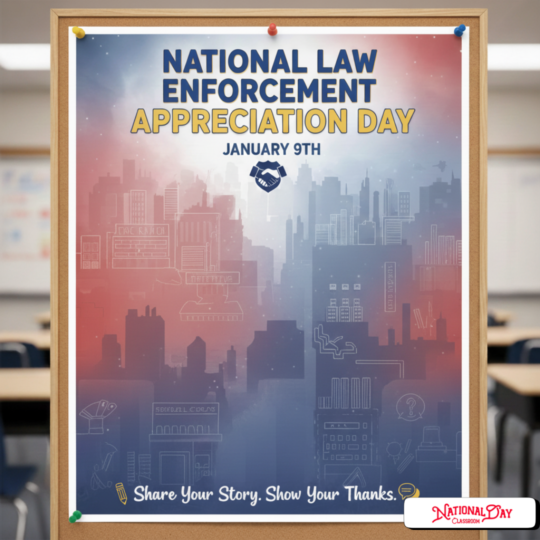
National Law Enforcement Appreciation Day (L.E.A.D.) is observed on January 9th. It’s a great opportunity to move beyond a simple “thank you” and help students (or community members) understand the complex, multifaceted role of those who serve in uniform.
Here is a structured lesson plan designed to be engaging, empathetic, and civic-minded.
Lesson Plan: The Shield and the Community
Goal: To analyze the duties of law enforcement and explore ways to build positive community relationships.
1. The “More Than a Ticket” Brainstorm
Start by asking the group to list every job a police officer does. Most will say “arrest bad guys” or “give speeding tickets.” Use a whiteboard to categorize their answers into:
- Public Safety: Responding to accidents, directing traffic.
- Social Work: Helping people in mental health crises, checking on the elderly.
- Investigation: Solving crimes, gathering evidence.
- Community Building: Visiting schools, coaching youth sports.
Key Takeaway: Officers are “generalists” who are often the first point of contact for any societal problem, requiring them to wear many different hats.
2. Perspectives: Life Behind the Badge
Watch a short video or read an interview with a local officer. Focus on the human element.
- The Sacrifice: Working holidays, missing family events, and the physical risks.
- The Emotional Weight: Dealing with people on their worst days.
- The Motivation: Ask, “Why would someone choose a job where people aren’t always happy to see you?”
3. Interactive Activity: The “Call for Service” Scenario
Break the group into small teams and give them a hypothetical scenario:
Scenario: A neighbor calls because a car has been parked on the sidewalk for three days, and there is a dog barking inside.
Ask the teams:
- What is the officer’s priority when they arrive?
- What different skills (patience, legal knowledge, physical strength) are needed?
- How does a “good” outcome look for both the officer and the neighbor?
4. Meaningful Appreciation (Action Steps)
Avoid generic gestures. Instead, focus on authentic connection:
- Letters of Impact: Write letters to the local precinct, but instead of just saying “thanks,” ask students to describe a specific quality they admire (e.g., bravery, patience, or helpfulness).
- The “Support the Support” Drive: Law enforcement families make sacrifices too. Collect items for a local “Police Unity Tour” or a foundation that supports families of fallen officers.
- Social Media “Shout-Out”: If you have a school or business account, share a story of a positive interaction with a local officer.
Discussion Questions
- How does the law enforcement role change in a big city versus a small town?
- How can citizens make an officer’s job easier and safer?
- What does “protect and serve” mean to you personally?
Writing Prompts:
🟢 Creative & Narrative Prompts
- A Day in the Life: “Imagine you are a K9 officer or a patrol officer starting a night shift at 10:00 PM. Describe the first two hours of your shift. What do you see, hear, and feel as the rest of the city goes to sleep?”
- The Unsung Hero: “Think of a time a police officer helped someone in a way that didn’t involve making an arrest (e.g., helping a stranded motorist, finding a lost pet, or visiting a school). Write a short story from the perspective of the person who was helped.”
🔵 Reflective & Civic Prompts
- The Meaning of the Badge: “The motto of many police departments is ‘To Protect and to Serve.’ Which of those two words do you think is more important in building a safe community, and why?”
- Building Bridges: “If you were the Chief of Police for one day, what is one event or program you would start to help officers and local teenagers understand each other better?”
- The Weight of the Uniform: “Law enforcement officers often work on holidays like Thanksgiving or New Year’s Day. Write a letter to an officer expressing why you appreciate their willingness to be away from their own family to keep yours safe.”
🟡 Analytical & Critical Thinking
- The Modern Officer: “How has technology (like body cameras, drones, or social media) changed the way police officers do their jobs compared to fifty years ago? Is it easier or harder to be an officer today?”
- Characteristics of Leadership: “List the three most important personality traits an officer should have (e.g., empathy, courage, calmness). Explain why a person needs all three to be successful in the field.”
How to use these:
- For Younger Students: Stick to the “Unsung Hero” or “Day in the Life” prompts to build empathy.
- For Teens/Adults: Use the “Building Bridges” or “Modern Officer” prompts to spark a classroom debate or essay.
Download the Lesson and Writing Prompt in PDF format here.