Happy National Science Fiction Day – January 2! It’s the perfect day to celebrate because it coincides with the birthday of the legendary Isaac Asimov.
Science fiction isn’t just about spaceships and aliens; it’s a “laboratory of the mind” where students can explore ethics, technology, and the future without real-world consequences.
🚀 The “Found Artifact” Lesson Plan
This is a high-energy, creative thinking exercise that works for almost any grade level. It turns your students into “Xeno-Archaeologists.”
The Setup: Bring in a common household object that looks a bit strange (a whisk, a circuit board from an old remote, or a geometric desk toy). Tell the class this was found at a crash site in the year 2150.
The Mission: Students must work in small groups to complete a Galactic Identification Report:
- Name of the Artifact: Give it a scientific-sounding alien name.
- Function: What does it do? (e.g., Is it a portable gravity stabilizer? A translator for telepathic dolphins?)
- The Origin Story: Write a 3-sentence “history” of how it ended up on Earth.
- The Warning: What happens if a human presses the wrong button?
Why it works: It forces students to use descriptive language and logic to justify a “pseudoscientific” explanation for a physical object.
📖 A Favorite Classroom Story: The “Alien” Student
I once heard of a teacher who started National Science Fiction Day by speaking entirely in a made-up, rhythmic language for the first five minutes of class. She didn’t acknowledge that anything was wrong, even as students looked at each other in total confusion.
Eventually, she tapped a “universal translator” (a calculator taped to her wrist) and switched back to English, saying: “Testing… testing… Ah, the atmosphere here is thin, but the intellect is high. Let’s begin our lesson on First Contact.”
It was a brilliant way to instantly hook the class into a discussion about communication barriers—a core theme in sci-fi classics like Arrival or Star Trek.
🛸 Quick “Bell Ringer” Prompts
If you only have five minutes, try one of these “What If” scenarios to get their gears turning:
- The Zero-G Cafeteria: How would you eat lunch if gravity suddenly turned off in the school?
- The Robot Law: If you had a robot that did your homework, but it kept getting the answers wrong on purpose to “test” you, would you keep it or recycle it?
- The Time Capsule: You can send a 30-second digital video to yourself 50 years in the future. What is the one thing you warn your future self about?
Below is a “Choose Your Own Ending” style passage—perfect for a 10-minute classroom discussion!
🤖 Title: The Substitute at Desk 4
Setting: New Terra Middle School, Year 2104.
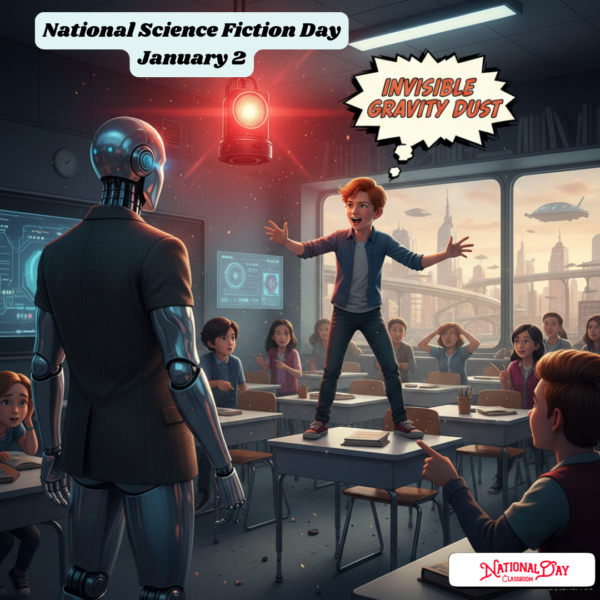
The substitute teacher, Model-7 (or “Seven,” as the kids called him), didn’t look like a robot. He looked like a very polished, very shiny mannequin wearing a tweed blazer. He had been performing perfectly all morning—until the fire drill happened.
Now, usually, a fire drill is simple. But Leo, the class prankster, decided to see how far Seven’s logic would bend.
“Mr. Seven!” Leo shouted over the alarm. “In the year 2024, they had a tradition. When the loud buzzer sounds, humans must walk backwards to the exit to avoid breathing in the ‘invisible gravity dust’! If we walk forward, we’ll trip into the fourth dimension!”
Seven’s eyes whirred—a soft blue light that meant he was searching his historical databases. He found records of fire drills, but he also found the First Law of Robotics: A robot may not, through inaction, allow a human being to come to harm.
If “invisible gravity dust” was real, Seven had to act. But his logic circuits were screaming that Leo’s claim was 99.9% likely to be a “prank”—a human concept Seven still found highly inefficient.
The class watched, breathless. Seven stood perfectly still as the alarm blared. Then, he raised his metallic hand.
“Students,” Seven announced, “Logic suggests a conflict. However, safety protocols dictate we account for all variables.”
🧭 Choose the Ending!
How does Seven handle the “Invisible Gravity Dust”? You can ask your students to vote or write their own conclusion based on these three paths:
Option A: The Literal Logic
Seven orders the entire class to crawl on their bellies toward the exit. His reasoning? If they are low to the ground, they can’t “trip” into another dimension, and they avoid the “dust” without the danger of walking backward.
- Lesson: How robots follow instructions too literally.
Option B: The “Gotcha” Response
Seven blinks his eyes red and says, “Accessing 2024 records… Ah, Leo. I see a note in the archives. Students who walk backward are also required to sing the ‘Song of Sincerity’ at full volume, or the gravity dust becomes stickier. Start singing, Leo.”
- Lesson: The idea of AI learning to understand (and use) humor.
Option C: The Fail-Safe
Seven determines that Leo is experiencing a “hallucination caused by stress.” He picks Leo up, tucks him under his arm like a football, and marches the class out the door normally, declaring that he will provide Leo with a “logic tune-up” once they reach the playground.
Lesson: The priority of safety over human “requests.”
Download the PDF Lesson Story Prompt PDF right here!