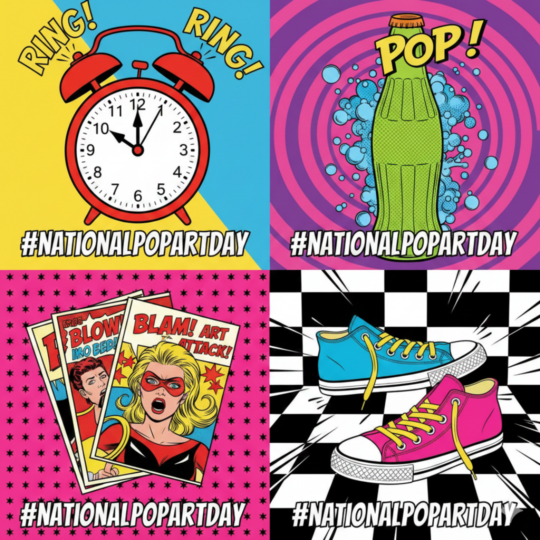
Students will understand that art can be inspired by everyday objects and will create their own masterpiece using bold colors, repetition, and “Ben-Day” dots.
1. The Hook: What is “Popular” Art?
- Discuss: Ask the class, “What are some things everyone knows or sees every day?” (Examples: cereal boxes, soda cans, sneakers, emojis, or video game characters).
- Explain: Tell them that in the 1950s and 60s, artists like Andy Warhol and Roy Lichtenstein decided that these “popular” things were just as important as fancy landscapes or portraits.
- Fun Fact: Point out that January 28th is officially National Pop Art Day to celebrate how this movement made art fun and accessible for everyone!
2. The Vocabulary (3 Key Elements)
- Bold Lines: Thick black outlines that make objects “pop” from the background.
- Primary Colors: Using bright Red, Blue, and Yellow (often straight from the tube).
- Onomatopoeia: “Sound words” often seen in comic books (POW! BAM! SNAP!).
3. Hands-On Activity Options
Option A: The “Soup Can” Re-Mix (Andy Warhol Style)
- The Task: Have students pick a modern “everyday” item (a smartphone, a Takis bag, a Starbucks cup).
- The Method: Fold a piece of paper into four quadrants. Draw the same object in each square.
- The “Pop” Factor: Use a different “wild” color scheme for each square (e.g., a purple iPhone with a green background in one, and a neon pink iPhone with a blue background in the next).
Option B: Comic Book Sound Effects (Roy Lichtenstein Style)
- The Task: Students choose a “sound word” (like ZAP! or CRUNCH!).
- The Method: Draw the word in large, blocky “bubble” letters inside a jagged starburst shape.
- The “Pop” Factor: Use Ben-Day Dots! Instead of coloring the background solid, use the eraser end of a pencil dipped in paint (or a marker) to make a grid of small dots to fill in the space.
4. Classroom “Gallery Walk”
Tape the finished projects to the wall in a grid. Because Pop Art is all about mass production and repetition, the wall will look like a professional art gallery display.
Wrap-up Questions:
- Why did you choose your specific object?
- How does the object look different when it has neon colors instead of normal colors?
- Does the repetition of the 4 squares make the object look more “important”?
Teacher Tips for National Pop Art Day:
- Snack Connection: Since Andy Warhol is famous for his soup cans, consider having a “Pop Art Picnic” with bright-colored snacks like fruit skewers or colorful crackers.
- Integration: Link this to English Language Arts by focusing on Onomatopoeia or to Social Studies by discussing how advertisements influence what we think is “cool.”
Reference Link for Students: National Pop Art Day – National Day Calendar