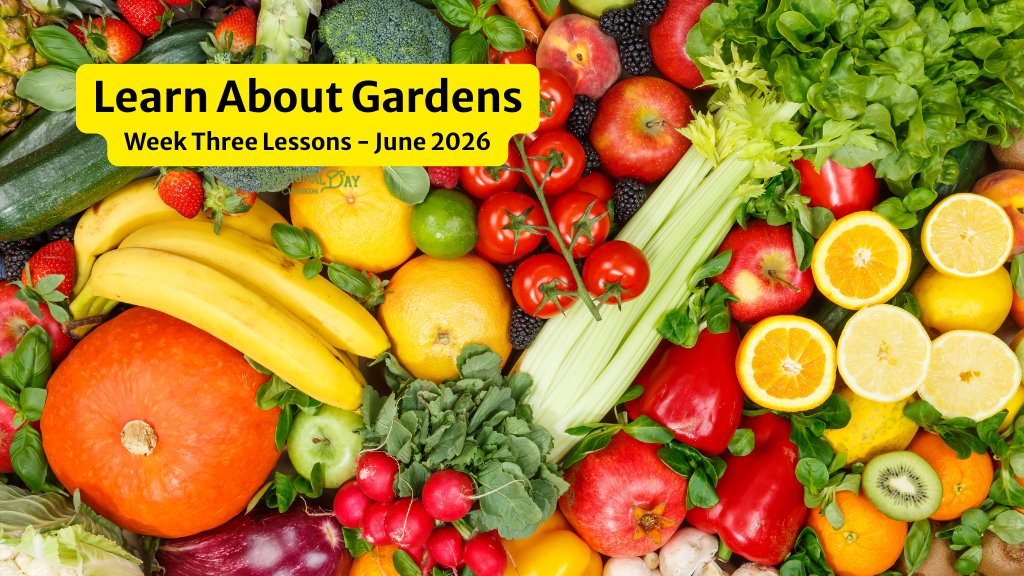
Week of Focus: Week Three of June
Target Community: Grades K–8
Theme: Culinary Chemistry, Plant Science, and Health Literacy
Introduction for Educators
Welcome to week three of June! Looking at your list, we have a wonderfully cohesive theme waiting to be unlocked: The Science, History, and Math of Food. This week’s calendar leans heavily into produce and pastry, making it the perfect vehicle to teach students about plant anatomy, food chemistry, and nutritional literacy.
By framing these days through a scientific lens, we can transform simple food appreciation into lessons on physical transformations (turning liquid cream into carbonated soda), geometric scaling (layering pastry dough), and the biological difference between fruits and vegetables.
The National Days Involved (And Their Educational Value)
- National Cucumber Day & National Eat Your Vegetables Day: Explores botanical classification (the surprising reason a cucumber isn’t a vegetable) and nutritional density.
- National Apple Strudel Day & National Cherry Tart Day: Investigates culinary math, structural engineering in baking, and the physics of heat transfer.
- National Ice Cream Soda Day: Serves as a classic, high-engagement chemistry lab dealing with states of matter, gas expansion, and chemical reactions.

Lesson Plan: Culinary Chemistry & Botany
Day 1: The Great Botanical Debate
National Day: National Cucumber Day
- Objective: Students will understand the botanical definition of a fruit versus the culinary definition of a vegetable by dissecting a cucumber.
Grade-Specific Activities:
- Grades K–2 (Seed Hunters): Slice cucumbers open in class. Have students use magnifying glasses to hunt for internal seeds. Teach them the basic golden rule: If it has seeds on the inside, science calls it a fruit!
- Grades 3–5 (Classification Station): Create a sorting game. Provide images of various produce (tomatoes, peppers, green beans, carrots, broccoli). Students must sort them into two categories: “Botanical Fruit” (has seeds) vs. “Botanical Vegetable” (roots, stems, or leaves).
- Grades 6–8 (Taxonomy & Cellular Structure): Dive deeper into Cucurbitaceae (the gourd family). Have students look at thin cucumber slices under a microscope or magnifying lens to observe cell walls and water retention, discussing how a cucumber stays up to 20 degrees cooler than the outside air temperature.
Day 2: Nutritional Literacy & Macro-Nutrients
National Day: National Eat Your Vegetables Day
- Objective: Students will analyze how different colored vegetables provide distinct vitamins and minerals, mapping out a “rainbow plate” for human health.
Grade-Specific Activities:
- Grades K–2 (Eat the Rainbow): Give students a blank plate drawing. Have them cut out or color vegetables from every color group (Red, Orange/Yellow, Green, Blue/Purple, White) and learn that different colors help different parts of their bodies grow strong.
- Grades 3–5 (The Fiber Challenge): Discuss why eating the whole vegetable is better than just drinking the juice. Run a simple demonstration showing how a coffee filter (representing dietary fiber) slows down the passage of water, explaining how fiber helps digestion.
- Grades 6–8 (Nutrition Label Analysis): Have students compare the macro-nutrients (carbohydrates, proteins, fats) and vitamins in dark leafy greens versus starchy vegetables (like potatoes). Discuss the concept of “nutrient density” and how to read nutritional labels accurately.
Day 3: Geometry & Structural Engineering in Baking
National Days: National Apple Strudel Day & National Cherry Tart Day
- Objective: Students will apply geometric concepts like scaling, surface area, and layering to understand how pastry chefs create structural textures.
Grade-Specific Activities:
- Grades K–2 (Shapes in the Bakery): Compare the geometric shapes of a strudel (rectangle/cylinder) and a tart (circle/fluted edge). Have students use playdough to mold these two distinct styles, practicing spatial awareness.
- Grades 3–5 (Fractions & Pastry Flaking): Use paper folding to demonstrate how strudel dough is layered (puff pastry style). Show how folding paper repeatedly doubles the layers exponentially ($2, 4, 8, 16, 32$), illustrating how tiny layers of fat create flaky pastry when steam expands them.
- Grades 6–8 (Surface Area vs. Volume): Compare a deep-dish cherry pie to a shallow cherry tart. Have students calculate or discuss how the surface-area-to-volume ratio affects cooking time and moisture evaporation. Why do tarts stay crisp while pies can get soggy?
Day 4: States of Matter & Gas Expansion Lab
National Day: National Ice Cream Soda Day
- Objective: Students will observe a physical chemical reaction, analyzing how dissolved carbon dioxide gas escapes a solution when introduced to a solid.
Grade-Specific Activities:
- Grades K–2 (Changing States): Mix vanilla ice cream (solid) with root beer or cream soda (liquid). Watch the foam form (gas). Have students identify all three states of matter occurring right in their cups.
- Grades 3–5 (The Chemistry of Foam): Explain nucleation. The rough, porous surface of ice cream gives the dissolved carbon dioxide bubbles in the soda a place to cling to and rapidly expand into a thick foam. Have students measure the height of the foam over a 3-minute period.
- Grades 6–8 (The Physics of Carbonation): Dive into Henry’s Law regarding gas solubility. Students will investigate how temperature and pressure affect how much gas can stay dissolved in a liquid, evaluating why warm soda fizzes much more violently than cold soda when ice cream is added.
Weekly Writing Prompts
Grades K–2
- Prompt 1 (Botany): Imagine a magical cucumber that grows as big as a house. What does the inside look like? Who lives inside it?
- Prompt 2 (Nutrition): If you had to convince a picky alien to eat a broccoli “tree” or a carrot stick, what would you tell them to make it sound delicious?
- Prompt 3 (Science): Describe what happens when ice cream melts. Where does the solid go, and what does it turn into?
Grades 3–5
- Prompt 1 (The Fruit Debate): Write a persuasive paragraph arguing why a tomato or a cucumber should officially be placed in the fruit section of the grocery store instead of the vegetable section.
- Prompt 2 (Pastry Design): You are a pastry chef designing the ultimate summer tart. Describe the geometric shape, the fruit layers, and how you will balance the sweet and sour flavors.
- Prompt 3 (States of Matter): Write a story from the perspective of a carbon dioxide bubble trapped inside a can of soda. Describe the moment the can is opened and you meet a scoop of ice cream!
Grades 6–8
- Prompt 1 (Food Geopolitics): Apples originated in Central Asia, cherries in the Mediterranean, and sugar in Southeast Asia—yet an apple strudel is a classic Austrian dish. Write a short essay on how global trade networks historical combined distinct regional plants into iconic national desserts.
- Prompt 2 (Public Health): Many schools have banned sugary treats like ice cream sodas from school lunches to promote health. Do you agree or disagree with using institutional rules to dictate nutrition? Defend your position with logical arguments.
- Prompt 3 (Biomimicry): Cucumbers use a high water content and specific skin structures to stay cool in the blazing sun. How can architects or material scientists study plant biology (biomimicry) to design cooler buildings or clothing for hot climates?